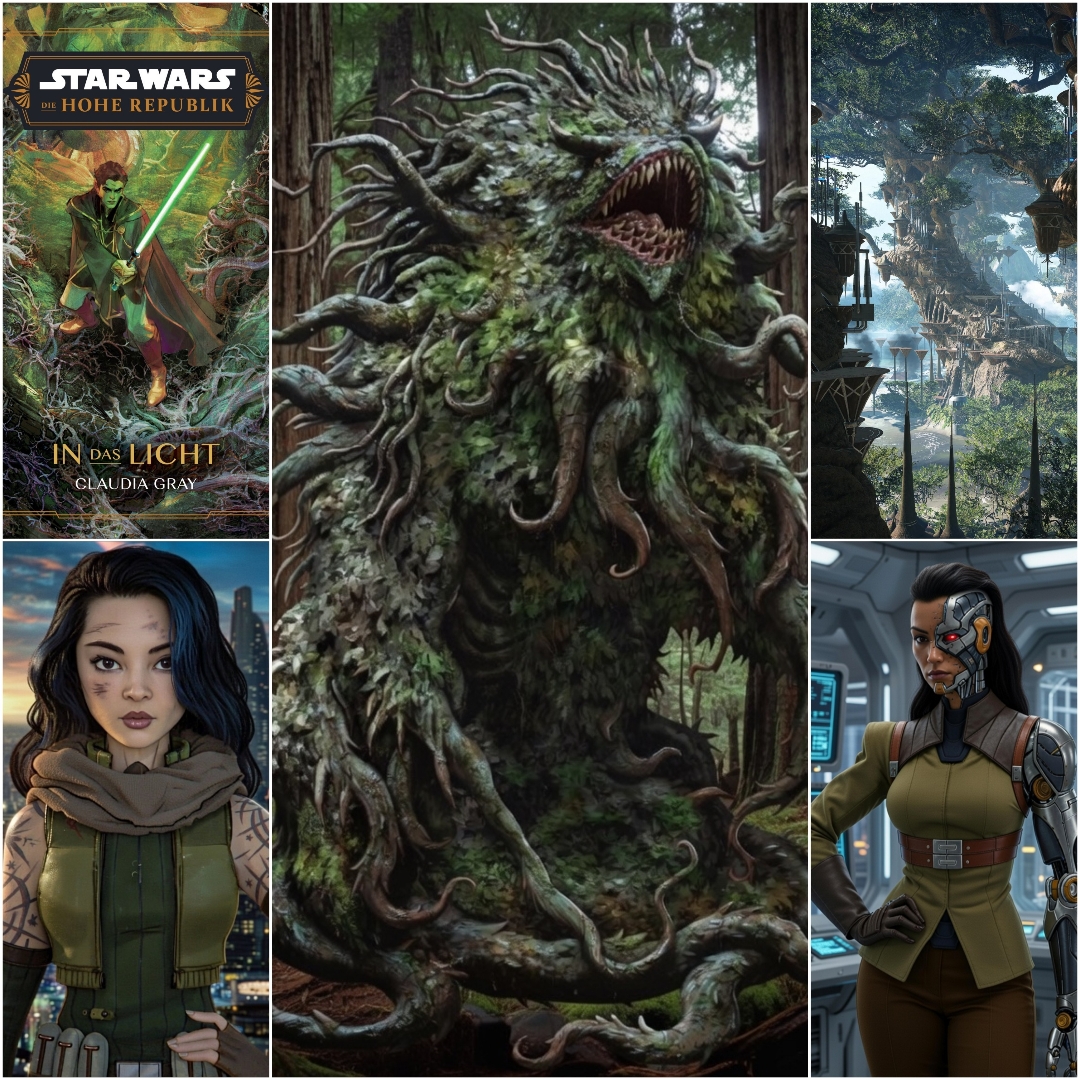
Star Wars: The High Republic Into the Light by Claudia Gray was a book I was cautiously optimistic about. Claudia Gray has written some very good Star Wars novels (Lost Stars, Leia: Princess of Alderaan, Bloodline and more), and I would also call Into the Dark one of the best High Republic books, which set a high bar for the YA line. Sadly, Into the Light doesn’t quite live up to that level though it’s definitely better than The Fallen Star. It’s a book with some standout moments, but also one that struggles with cohesion, payoff, and staying connected to the broader initiative.<spoiler> One of the things I appreciated most was the return of actual worldbuilding — something that has been mostly missing since Phase I. I often use The Rising Storm as a benchmark for how well the High Republic can immerse you in the galaxy, and in that regard, Into the Light felt like a small return to form. The highlight here was without question the inclusion of Kenari, the planet first introduced in Andor. Gray notes in the acknowledgements how much she loves the series, and it really shows. By tying Kenari to Czerka exploitation, she not only gives weight to the planet’s suffering but also connects the High Republic era to later and previously published stories in a satisfying way. It’s exactly the kind of worldbuilding I love reminiscent of how James Luceno used to seamlessly tie various parts of the galaxy together. It makes the galaxy feel textured and layered, rather than episodic.Another element that stood out was the introduction of the Thornseed an ancient Sith weapon that, despite being new to Star Wars, fits almost too well into the puzzle. It adds yet another piece suggesting that the Sith may have played a role in the creation of the Blight, and perhaps even the Nameless. It’s an intriguing connection that strengthens the sense of an underlying threat while deepening the mystery. It also makes Azlin Rell’s strange behavior more compelling. His use of Force lightning is unexpected, but not without context throughout Phase III, he's been hinting at knowledge of the Sith, even referencing them explicitly in Shadows of Starlight as one of the groups being threatened by the Nameless, despite the Sith supposedly being extinct. His presence raises serious questions, and while the book doesn’t resolve them, it plants fascinating seeds. I also really liked the inclusion of Kelnacca from The Acolyte a small but effective way to weave in other corners of the canon without forcing it.That said, the book suffers from the same disjointed character work that has plagued much of the YA line. Reath is a character I’ve always liked, but his development feels stuck in a loop. Each book pairs him with someone new, Dez in Into the Dark, Ram in Midnight Horizon, and now Amaddeo and Nan (who was also present in Into the Dark, though more as an antagonist than a friend) but these relationships rarely have lasting impact. His chemistry with Ram in Midnight Horizon was fantastic, yet here it's basically erased. Amaddeo, who had a major role in Tears of the Nameless, is barely even present. Reath’s journey feels static, and even the resolution (or lack thereof) in this book leaves him in a strange emotional limbo.Worse still, many story threads from Tears of the Nameless are dropped or reduced to throwaway lines. The ancient Tolemite civilization, the metal that seemed to offer some form of protection or counter to the Nameless, Silandra Sho’s shield all of it either ignored or vaguely referenced. Even Marchion Ro, once a central and constantly evolving antagonist, now feels directionless. He’s present, yes, but doesn’t do much of anything. In Phase I, he was full of surprises; in Phase III, he feels like a leftover piece the writers don’t quite know what to do with or perhaps are saving for the grand finale of the initiative.The book also suffers from an increasingly frustrating reliance on outside media. The reappearance of the Drengir aboard the Innovator is one example without the Seeds of the Past and Haunted Starlight audio dramas, the scene makes little sense. This was already a problem in The Fallen Star, and it reappears here. Requiring readers to engage with every piece of High Republic media across multiple formats to understand basic plot elements should not be the way to go.There are also timeline inconsistencies that hurt the overall cohesion. For instance, the events of Light of the Jedi and Into the Dark are established to span at least a month, but this book compresses that gap into “a few days.” Reath reflects on his time training with Cohmac as lasting only a few months, when in reality, it's been about two years. While it’s true that Phase III takes place roughly a year after Phase I, the way it's framed makes it feel like almost no time has passed since the start of the initiative. These are relatively small details, but they add up and create a sense that the editorial team isn’t fully aligned.Despite all that, there are moments that genuinely shine. Nan’s storyline is well done and gets a fitting resolution. Gray’s writing is still emotionally effective, and there are scenes that genuinely land. But the book overall feels fragmented as if it’s trying to close the door on the YA series while not quite knowing how to do it. There are too many threads, too many ideas only partially explored. And with Trials of the Jedi on the horizon, I’m honestly unsure how all of this will be wrapped up or if it even will be. </spoiler>If you're deeply invested in The High Republic and enjoy piecing together lore, Into the Light still has value. But if you're looking for answers, narrative payoff, or the sense that the initiative is building toward a satisfying end, this one might leave you frustrated.